Posts

Showing posts with the label thinking classroom

The Shift Show EDU - ReTHINKing the Classroom

Image
 In this episode of the Shift Show EDU, the Shift Team sits down with Muhammad Zia , acting program lead of Science at the Virtual Secondary School in the Halton District School Board to talk about experimenting with new methods of teaching and learning in a virtual class.  Muhammad worked with Shift Coach Rachel Johnson to experiment with the implementation of the Thinking Classroom, a classroom learning model developed by Dr. Peter Liljedahl , professor of education at Simon Fraser University.  Incidentally, Liljedahl has recently released a book on Building Thinking Classrooms and Nicole Jarvis , Instructional Program Lead for Mathematics in HDSB is leading educators through the implementation of this model of teaching. Continuing our #thinkingclassroom journey with @pgliljedahl and @MsBriggsHDSB . Manipulative, white boards and lots of thinking! @HDSBSecProgram @HaltonDSB @HDSBMath @irhs1 pic.twitter.com/CjDpDNBBxo — Nicole Jarvis (@NicoleJarvis18) Novembe...

Collaborative Thinking

Image
  Being embedded as coaches in a school is providing The Shift with many unique opportunities to collaborate with other teachers.  Two weeks ago, we were approached by two Milton District High School Science teachers who had heard about the Thinking Classroom and wanted to try it out with their Grade Nine Science students.  This was exciting, because it was going to be a challenge for us as well as them. Our own areas of expertise currently lay outside of the science curriculum, we could bring the strategies of the Thinking Classroom to the table, but as far as knowing how to apply it to individual topics, we were at the mercy of the classroom teachers.  But this is how we like to learn and grow, collaboratively. The topic in question was Bohr Rutherford diagrams and the periodic table.  This is traditionally taught by the teacher leading a lesson on atomic theory, the parts of the atom, how to draw Bohr Rutherford diagrams and then, how these diagrams related...

Note Taking in a Thinking Classroom

Image
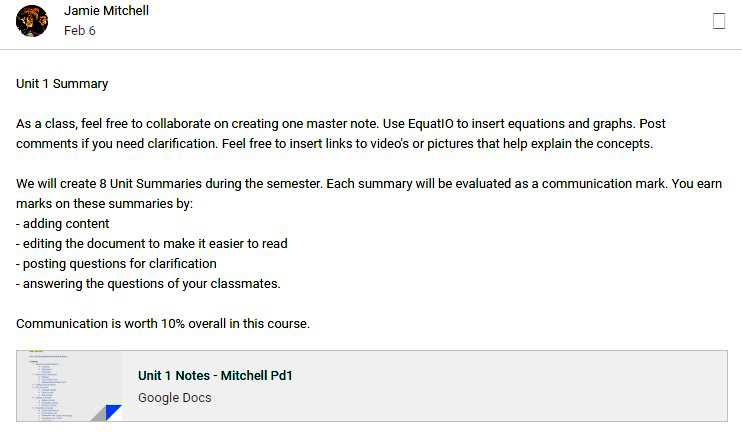
I came across a thread on twitter a month or so ago.  It was about a professor who discovered that her students had spent all semester collaborating on one large google doc.  They took notes together, asked and answered questions of each other.  It was a great example of collaboration. I learned today that a group of students used a Google doc to take lecture notes-- they all took notes simultaneously in a collective file. — stephanie (@mckellogs) December 20, 2016 And I thought to myself, “I wonder if my students would be willing to try something like that”.  I knew I’d be running a classroom where students were up at the whiteboards daily, working on problems together.  I also realized that this might impact their ability to take coherent notes. So, at the start of this semester, I created a mostly blank google doc and shared it with my students.  I provided the first few lesson titles and suggested that they use this space to collect their ...

Cycling Back to the Beginning

Image
It’s the last week before the holiday break.  When I teach grade nine math my goal is to always wrap up the teaching of curriculum before the break.  I do this for two reasons.  First, so that we can spend two weeks engaging in review activities to help prepare for the final exam, which in this case is the EQAO.  The second reason is so that we can play around with a final performance task that is a bit more open than usual. I had no idea if this plan would hold up now that our grade nine course team was trying a blend of project based learning.  When I step back and think about what our team has accomplished over these four months, I’m pretty pleased.  We started the semester with a question that was very loosely defined, “Can we teach Grade Nine Math using projects?”.  We took a risk and dove in. After playing with Barbie Bungee , Dandy Candies and some intentionally frustrating algebra problems we decided on our next focus:  We wanted t...

Why the heck did I do that?

Image
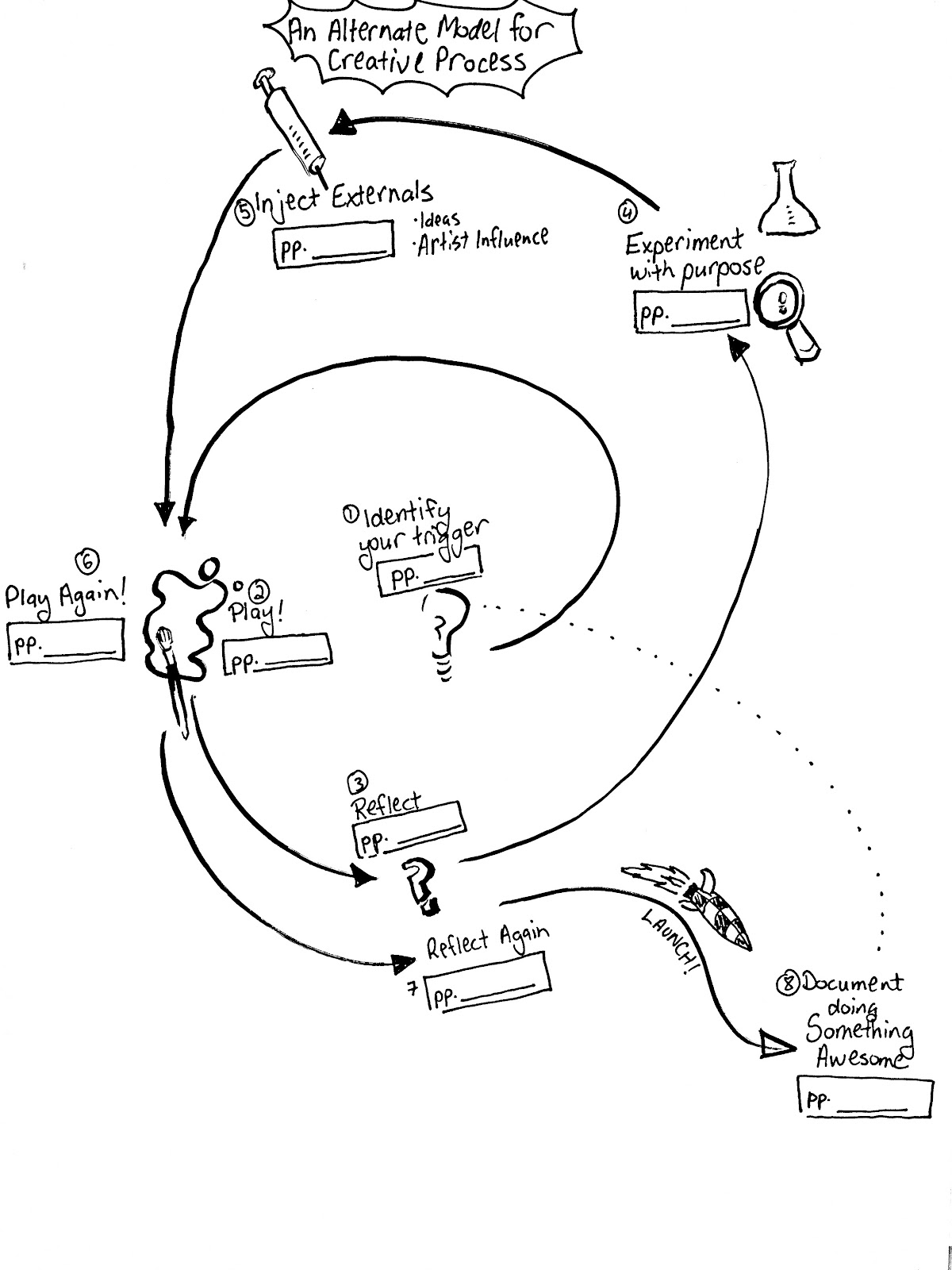
“Why the heck did I DO that?”   Have you ever found yourself asking that question after teaching a lesson?  I did, a week or so ago.  I delivered a classic “powerpoint”, with teenager eyes glazing over but I’m powering forward and getting through my slides because “that is the lesson”.  Immediately after finishing the period, I realized I messed up. Students had probably retained 5% of the information that I just talked at them about.  This stung a little, especially since what I just did flew in the face of my current “WHY” as a teacher. One iteration of the creative process we are playing with. Let me back up and give you a bit of context.  I’m an art and photography teacher and my colleagues and I are really pushing hard to reimagine the creative process. WHY are we doing this?  We are finding that when students’ experiment within the creative process and are not evaluated, they engage more in the risk taking and truly embrace their...